


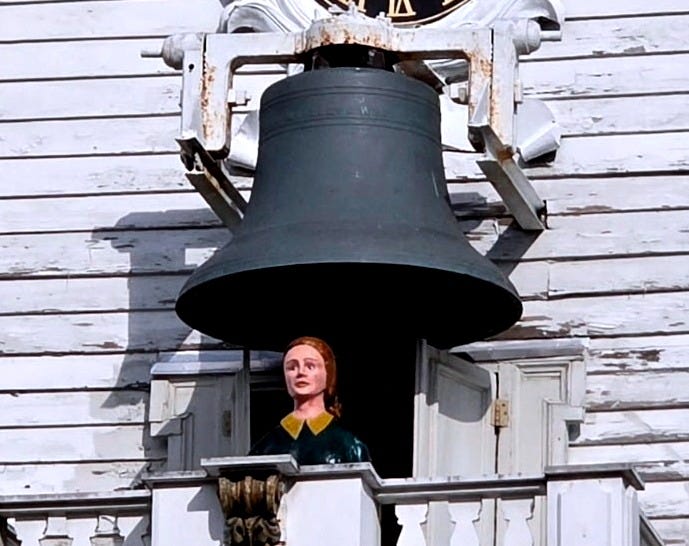
Many years ago, I stood in front of a clock tower in downtown Granville, Ohio, watching a small statue of a woman appear like a cuckoo to mark the top of the hour with a unique combination of authority and whimsy. The Victoria Woodhull clock tower is part of the Robbins Hunter Museum, and it is this monument that first introduced me to an important historical figure.
The fact that I didn’t know of Victoria Woodhull as an adult was disturbing. As an Ohioan who learned Ohio history and considers herself a feminist, I had never heard of Victoria, the first woman to run for the U.S. Presidency, and I wondered why. Her story began to come up in small ways over the years, and this led me to read more about her. A social post ultimately pulled the string that got me researching her, and over the last few years, this research led me down an interesting path of discovery.
I consider myself creative (obv), but I’d be hard-pressed to ever imagine a character as enigmatic as Victoria Woodhull. She was a woman of firsts, who made being disenfranchised look like a superpower. It was the erasure of her story that propelled me forward in my personal investigation, but it was also her seeming anticipation of this erasure.
When I began to write about Victoria, what drove me became less about why she was erased and more about how she lived (in a way in which no one would believe her story anyway). I found myself propelled by two questions: Who was this woman, really, and how did she find the fortitude to accomplish so much in one lifetime?
Victoria’s life was filled with enough drama to fill many volumes, but my sincere hope with RADICALS is to explore something different than scandal and suffrage.
I want to explore some semblance of the interiority of a woman who was able to accomplish so much with so few rights. To make the mystery more intense, my research quickly revealed many conflicting stories. I explored clips from her political campaigns and letters, hateful critiques of her beliefs, local news stories that claimed certain things happened on certain dates, while biographies claimed they happened on other dates. Then there were commissioned biographies and Victoria’s own publications. Across these readings, I met many versions of one woman, and I strove to explore these versions with curiosity, not supposition.
A few “facts” overlap. Victoria grew up in poverty; she endured myriad abuses that influenced her political beliefs. Undereducated, she found mentors and leveraged an uncanny ability to understand human behavior to become a self-educated charismatic leader who advocated for women’s rights and a desire for all people to have “untrammeled” lives. She spoke, unabashedly, of beliefs that were radical in the nineteenth century, notably that spirits were guiding her and that every person should have the right to love whomever they choose however they choose.
Ultimately, Victoria found herself surrounded by controversy. She found a way to align herself and get funding from those who were benefiting most from the American system she railed against during the Gilded Age. Even when she became incredibly wealthy herself, largely thanks to the backing of Cornelius Vanderbilt, she advocated for the poor and disenfranchised.
The Licking County Historical Society archives in Ohio provided me with access to Victoria’s personal writings, including the start of a memoir. In it, Victoria states her belief that she was led by spirits, notably the spirit of Greek orator Demosthenes, who she considered a spirit guide and mentor along her quest for power. Victoria’s belief system seemed foundational to her courage. In a world where she did not have much freedom, it seemed she was able to find strength to do the impossible by believing she had the support of those in other realms.
I want to be clear that Radicals is a work of fiction. I do not know another way to tell Victoria’s story without falling into assumption and bias. At first, I thought I’d tell Victoria’s story in the third person, but her character demanded more attention. Then, I thought it would be just her story, but the parallels between the Gilded Age and the America of today begged to be explored, so I introduced a modern timeline.
While this novel is largely influenced by Victoria’s story, Avery plays the role of a filter and philosopher. While Avery takes her own journey toward personal empowerment, she also allows a different view of the past and exposes many of the dilemmas we face today as she finds her own political voice through theater. Much like Victoria was influenced by mythology and spiritual guides, Avery is influenced by the mythology and spirit of Victoria.
I leveraged the scaffolding of a historical timeline to explore Victoria’s life, following her relationships and businesses and campaigns for both business and office. But these accomplishments and dynamics are secondary to me. Who she was and why she was able to succeed in any capacity, despite the odds, seemed an interesting juxtaposition against a modern character who feels powerless, even while having many more rights on paper.
In our modern times, how does a person stand up for what they believe when they don’t know where to begin?
And with all our conveniences, can we still find strength from those who accomplished the seemingly impossible hundreds of years before when much communication took place in person? I began to wonder what Victoria would have to say about what is going on today, in 2026.
I believe that we have a lot to gain from exploring historical figures through the lens of fiction, especially those whose stories have been muddied by time and political motive. After all, it is only by admitting the fictions and exploring stories from new angles that we can find our way to some semblance of truth.
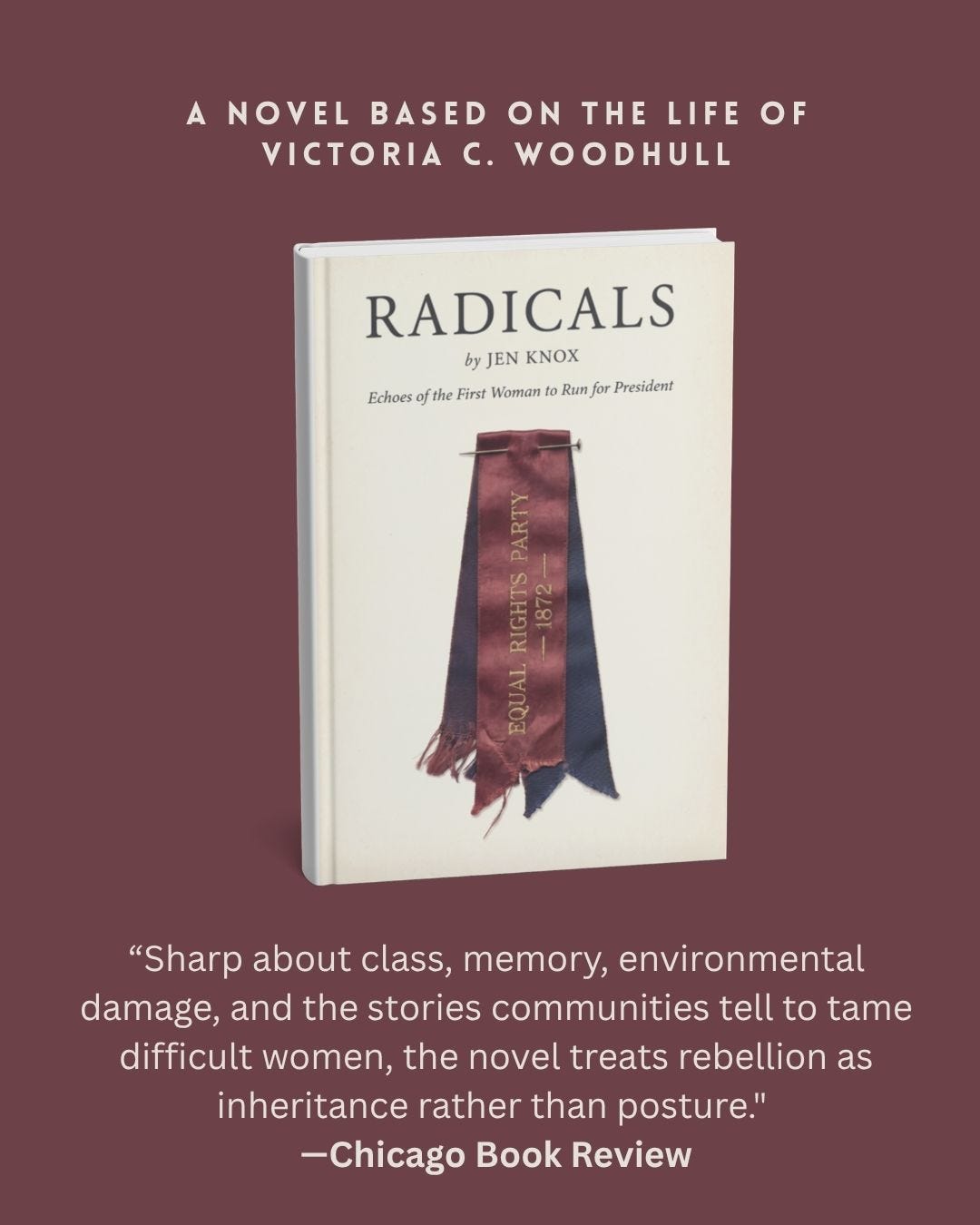
All this to say, my novel is now available for pre-order. Distribution is just getting going. I hope it does this enigmatic woman justice and, if nothing else, asks questions we need to ask about our absurd reality today. How might Victoria respond to the America of today?
The full link to order direct from the publisher, along with all populating buy links through Simon and Schuster are here. If you enjoy it, please share in reviews or with friends … this book didn’t come easy (case-in-point).
Cheers!!
Prompt: Write about someone, real or imagined, who breaks barriers. Explore the full human, not just the heroic figure.

Life prompt: Join me on Halloween for a mind-body event. Attend our next write-in on Nov 12. Yesterday’s was nourishing.